

A guide to director penalties for unpaid superannuation – what it means for voluntary disclosures and personal liability.
1. The director penalty regime
If a company doesn't pay its PAYG withholding, GST[1] or superannuation[2] on time, a director becomes personally liable for a penalty (“director penalty”) equal to that debt under Division 269 of Schedule 1 to the Taxation Administration Act 1953 (Cth) (TAA).
A common misconception is that personal liability is imposed by the Australian Taxation Office (ATO) when it issues a Director Penalty Notice (DPN). This is not the case – personal liability is imposed automatically by operation of law as soon as the company fails to pay the debt on time[3]. The DPN is simply the precondition the ATO must satisfy before it can recover the director penalty from a director personally – that is, the ATO cannot take steps to recover the penalty amounts from a director until 21 days after they issue a DPN[4].
In certain circumstances a director penalty can be remitted, by placing the company into external administration (“non‑lockdown” penalty). If a director penalty is remitted a director will no longer need to pay the liability.
2. What is the "due day" and why does it matter
Reporting the unpaid amount (the obligation) to the ATO within prescribed timeframes is the trigger for whether a director penalty is a “non‑lockdown” penalty (which can be remitted) or a “lockdown” penalty (which only payment in full can clear).
A non-lockdown penalty will arise where the company has reported the obligation:
for PAYG withholding and GST, within three months of the due day for lodgment of BAS and IAS;
for superannuation (up to 30 June 2026), by the due day for lodgment of the Superannuation Guarantee Charge (SGC) statement[5].
If the obligation is not reported within these timeframes, the director penalty converts to a lockdown penalty. A lockdown penalty cannot be remitted by placing the company into external administration. Therefore, a director will need to pay the debt personally if the company is unable to.
From 1 July 2026, Payday Super abolished the SGC statement regime. As a result, the former SGC statement lodgment deadline no longer operates as the “due day” for superannuation-related lockdown penalties.
3. How the “due day” is now calculated for superannuation (from 1 July 2026)
Under Payday Super, superannuation is no longer paid quarterly. Exposure now arises payday‑by‑payday (potentially 52 times a year rather than four).
Contributions must reach the employee's fund within seven business days (in most cases) of each payday (the "qualifying earnings" or QE day). There is no longer an SGC statement to lodge if payment is not made on time. Instead, the company can report the obligation by lodging a voluntary disclosure statement (VDS), or the ATO will assess the SGC itself from real-time payroll data.
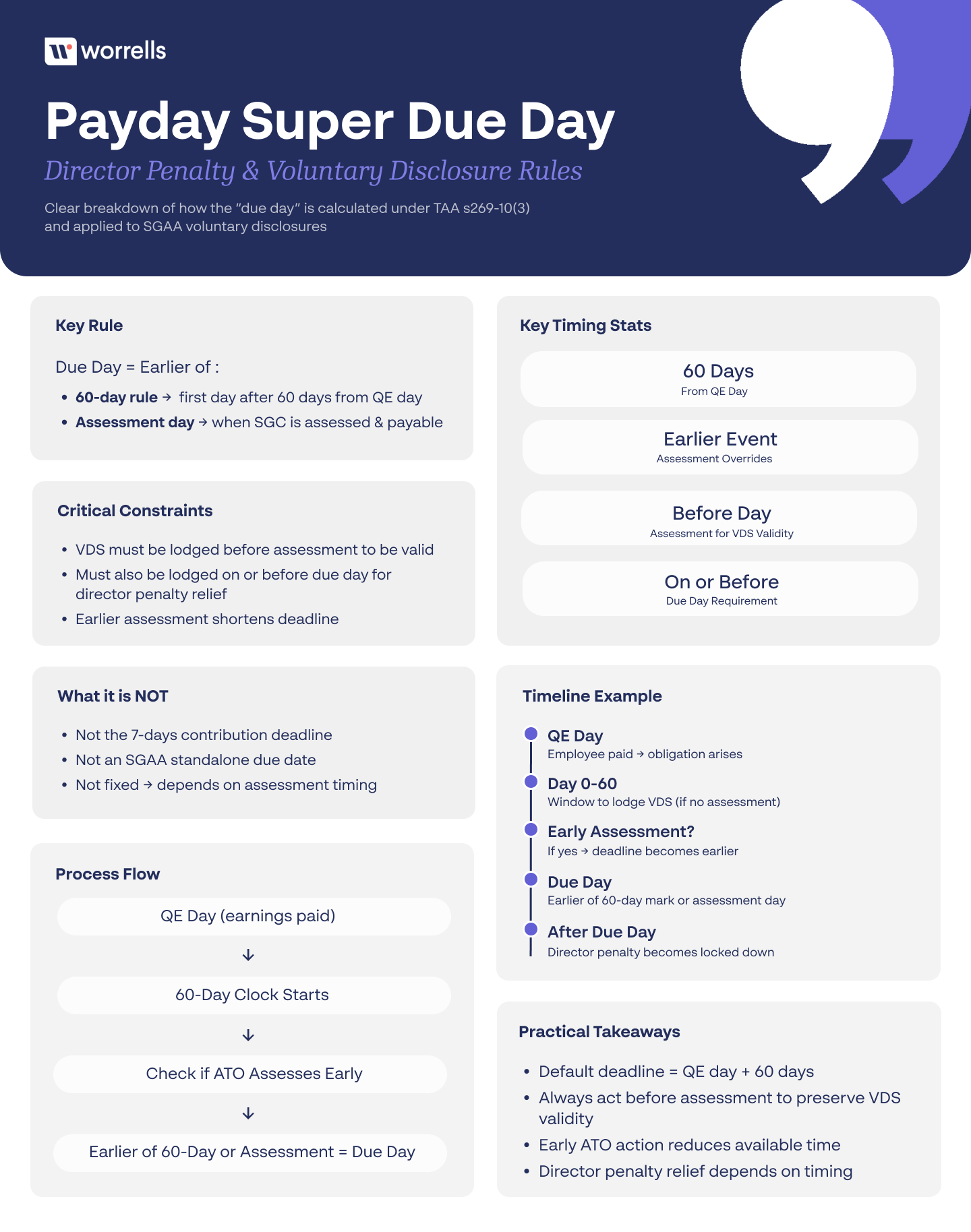
Given lodgment of a VDS is voluntary, there is no “due day” as applied for lodgment of a SGC statement. Amendments were made to the TAA so that, for director penalty purposes, the “due day” is now the earlier of [6] & [7]:
the first day after the 60‑day period starting on the QE day; or
the day the SGC becomes payable under an ATO assessment.
Because SGC under an ATO assessment is payable on the day the assessment is made[8], an early assessment can pull the due day forward and lockdown a director’s personal liability well inside the 60 days.
4. Voluntary disclosure statements – the new relief valve
The VDS now effectively performs the role previously served by the SGC statement. Two key rules apply with the VDS:
It must be lodged before the ATO issues an assessment for that QE day. Once the ATO issues an assessment, the disclosure window closes.
It reduces the administrative uplift, not the underlying SGC debt. The uplift can be up to 60% of the shortfall plus notional earnings. Lodging within 30 days of the QE day can reduce it by up to 40 percentage points, to 20%, and possibly to nil if there has been no ATO‑initiated SGC assessment in the previous two years.
5. Quick calendar example
If a VDS is not lodged within 60 days of the QE day and before the ATO issues an assessment, the director penalty locks down, and a director will need to pay the debt personally if the company is unable to.
Event | Timing | Effect |
QE day (payday) | Day 0 | 7‑business‑day and 60‑day clocks start |
On‑time deadline | +7 business days | Contribution must reach fund |
VDS lodged | <30 days | Uplift cut from 60% → 20% (possibly nil) |
Due day — limb 1 | ~Day 61 | First day after the 60‑day period … |
Due day — limb 2 | Assessment day | … unless the ATO assesses earlier |
The trigger for a lockdown penalty crystallises at the end of whichever “due day” comes first (limb 1 or limb 2).
6. Remitting the director penalty
This is where the difference between a non‑lockdown and a lockdown penalty becomes decisive:
(a) Non‑lockdown penalty – remission by payment or external administration
As set out above, a non‑lockdown director penalty arises where the company reported the obligation within the prescribed timeframe. For superannuation:
this historically meant lodging by the SGC due date;
under Payday Super it is the earlier of lodgment of a VDS (if within 60 days of the QE day), or the ATO assessing the SGC itself.
A non-lockdown penalty is remitted (i.e. cancelled) if, before or within 21 days of a DPN being issued, either [9]:
the company pays the amount outstanding in full;
an administrator is appointed to the company;
a small business restructuring practitioner is appointed to the company;
the company begins to be wound up (within the meaning of the Corporations Act 2001).
It is important to note that entering into a payment plan with the ATO will not remit the penalty.
If the company fails to do one of these things within 21 days of the DPN being issued, the director penalty permanently locks down on the director (i.e. becomes a lockdown penalty), and the ATO can commence proceedings against the director to recover the debt.
(b) Lockdown penalties – remission by payment only
Where the company failed to report the obligation within the prescribed timeframe, the penalty locks down, and only payment in full removes personal liability. Appointing an administrator or liquidator after the penalty locks down is too late to resolve a director’s personal liability. We regularly see cases where the ATO issues DPNs for lockdown director penalties for companies that have already been restructured or liquidated.
7. Practical takeaways
For the period prior to 30 June 2026, lockdown penalties will continue to be driven by the due day for lodgment of the SGC statement. Lodging the SGC Statement on time is critical to avoiding lockdown director penalties.
From 1 July 2026, for director penalty purposes the SGC due day is the earlier of 60 days after payday or the ATO assessment day. Therefore, timely lodgment of a VDS is critical to avoiding lockdown director penalties:
Lodge a VDS within 60 days of the QE day and before an ATO assessment;
Missing it means personal liability locks down on the director, and you lose the uplift concession.
Under Payday Super:
Exposure arises payday-by-payday, rather than quarterly, so missed contributions can create repeated and more frequent personal liability risks.
Because the ATO can assess from real-time payroll data, a lockdown penalty may arise much faster than under the former “one month and 28 days from end of quarter” buffer that applied up to 30 June 2026.
Seek advice within the 21-day window of a DPN being issued – for a non-lockdown DPN in particular, pay the debt or consider appointing an external administrator; a payment plan won't remit personal liability.
For more information and/or confidential advice, speak to a Worrells Principal.
[1] From 1 April 2020.
[2] From 30 June 2012.
[3] Subsection 269‑20 in Schedule 1 to the Taxation Administration Act 1953 (Cth).
[4] Subsection 269‑25 in Schedule 1 to the Taxation Administration Act 1953 (Cth).
[5] For the March 2019 quarter and earlier, the lodgment timeframe is within three months of the due date for lodgment of the SGC statement.
[6] Subsection 269‑30(2) in Schedule 1 (table item 3) to the Taxation Administration Act 1953 (Cth) was repealed and substituted with:
3 | superannuation guarantee charge for a *QE day, | the due day, | (a) if the company, on or before the due day, lodges under section 33 of the Superannuation Guarantee (Administration) Act 1992 a voluntary disclosure statement for the QE day—the extent (if any) that the amount of superannuation guarantee charge worked out using that statement is less than the amount of superannuation guarantee charge the company is obliged to pay for the QE day; or (b) otherwise—to any extent. |
[7] Subsection 269‑10(3) in Schedule 1 to the Taxation Administration Act 1953 (Cth) was repealed and substituted with:
Superannuation guarantee charge
(3) For the purposes of this Division, the company’s superannuation guarantee charge for a *QE day under the Superannuation Guarantee (Administration) Act 1992 is treated as being payable on the earlier of the following days (the due day):
(a) the first day after the end of the 60‑day period starting on the QE day;
(b) the day the charge is payable (see subsection 36(4) of that Act);
even if, if paragraph (a) of this subsection applies, the charge has not yet been assessed under that Act.
[8] Superannuation Guarantee (Administration) Act 1992 (Cth) – s 36(4).
[9] Subsection 269‑30 in Schedule 1 to the Taxation Administration Act 1953 (Cth).


