

ASIC has just released a report examining 5 years of liquidation data, from 1 July 2021 to 30 June 2025.
The regulator examined 29,759 companies that entered court liquidation or creditors' voluntary liquidation during that period, grouped into 26,664 appointments. Those appointments reported $117.2 billion in liabilities, with median liabilities of approximately $479,000.
Half of liquidations realised $10,000 or less in gross assets. Around one-quarter realised nothing at all.
For those of us working in insolvency, that isn't particularly surprising. But it helps explain the outcomes usually experienced by creditors and importantly prompts a broader discussion about the insolvency regime as a whole.
A Services Based Economy
It is easy to assume that a company which has operated for several years must have accumulated assets somewhere along the way. Often, it hasn't.
This is particularly evident in businesses that provide services. While a business may have operated as a successful healthcare practice, advertising agency, recruiter or consultant, its physical assets may be limited to laptops, monitors, office furniture and equipment. By the time those assets reach a liquidation sale, they often have negligible value.
Another common scenario I have observed is a material investment into the premises. Hundreds of thousands of dollars can be spent fitting out a restaurant, gym, retail store, hairdresser or office. It represents a high cost in establishing the business, but in a liquidation, much of that expenditure may produce little or no recoverable value. Depending on the lease and circumstances, fixtures will usually become the property of the landlord by default.
Then there are financed assets. A $70,000 motor vehicle isn't a $70,000 asset available to creditors if $75,000 remains owing to the secured financier. What matters in the liquidation is the equity. Post-COVID creditors benefited from strong demand for motor vehicles. Post fuel-shock the opposite has occurred, with demand for motor vehicles down, which has resulted in more vehicles having negative equity.
Another common scenario is companies that have been incorporated as trading vehicles. An entity may be established so that a person or small group can contract through it and employ staff. It can operate a genuine business for years without ever building a meaningful pool of saleable assets.
Liquidations with saleable plant and equipment, unencumbered vehicles, large debtor books or other recoverable assets are not common, as borne out by the below numbers.
A 0.04 Asset/Liability Ratio
A metric often used when assessing solvency is the current ratio: current assets divided by current liabilities. A healthy business will generally have a current ratio greater than 1.0, indicating that it has sufficient current assets (assets that can be realised within 12 months) to cover current liabilities (liabilities that will fall due within 12 months).
ASIC’s number crunching identified that across 5 years of corporate insolvencies, $31.4 billion was owed to creditors, but only $1.3 billion in gross assets were realised. That represents a ratio of 0.04.
Some 45.8% of those liquidations realised no more than 1% of their liabilities. Only 10.6% realised assets exceeding 20% of reported liabilities.
And those are gross assets, before liquidation costs and claims ranking ahead of ordinary unsecured creditors.
A Dividend is Unlikely
When a creditor receives a report from a liquidator, I assume they thumb through the report (or scroll) to look for one thing: the dividend section.
Unfortunately, it is very likely that the liquidator will advise that there is no likelihood of a dividend. Of 18,176 finalised liquidations with available data, only 5.3% reported paying a dividend to ordinary unsecured creditors.
Even where a dividend was paid, the median return was 9.8 cents in the dollar. Just 67 appointments reported paying ordinary unsecured creditors in full over the course of 5 years.
Dividend rate of unsecured creditors for finalised liquidations
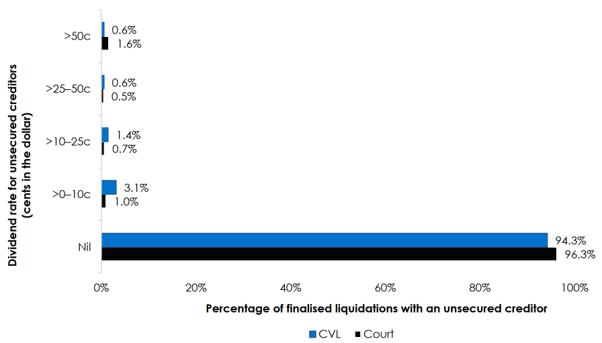 Source: ASIC’s Review of court and creditors’ voluntary liquidation process: 2021-2025, Figure 6
Recovery Actions: Theory Versus Practice
Another statistic initially seems difficult to reconcile with those poor returns.
Liquidators identified a potential recovery action in 84.1% of initial statutory reports to creditors. Yet among finalised liquidations, only 8.9% reported an actual recovery of the type analysed by ASIC (please refer to the report for further commentary on these numbers).
Where recoveries were reported, they were usually modest. The median recovery for finalised appointments reporting a recovery was $20,878. Across all 26,664 appointments, only 18 reported recoveries exceeding $1 million under ASIC's recovery analysis.
The report confirms something we see in practice; identifying a potential claim is not the same thing as having a commercially recoverable claim.
ASIC identifies several reasons why a potential action may not lead to a recovery. Further investigation may show that the elements cannot be established. The likely return may not justify the cost and risk. Funding or information may be unavailable. Most importantly, the prospective defendant may simply have insufficient assets.
That accords with what we see in practice. Legal recoveries are expensive, risky and contingent on a defendant having assets with which to actually pay any judgement.
For many small-business owners, the business failure has already consumed a substantial part of their personal wealth. I have seen young directors invest what would otherwise have been their house deposit into establishing a business or acquiring a franchise. They simply have no assets to pursue.
A strong claim against somebody with no capacity to satisfy a judgment is not necessarily a commercially viable claim.
Is that a failure of the insolvency system or corporate regime?
In my opinion, no.
There is a balance here that is sometimes lost in discussions about corporate insolvency. Australia needs a system in which people can start businesses, employ people, invest capital and take commercial risks. Some of those businesses will fail.
A system that attempted to eliminate business failure by imposing unlimited personal consequences on every entrepreneur would create problems of its own.
The challenge is therefore balancing creditor protection and accountability against the cost and complexity of regulation and the need to allow genuine commercial risk-taking. There is, however, a legitimate policy question about whether recoveries could sometimes be made more efficiently.
If certain liquidator recovery actions could be pursued with greater reliance on statutory presumptions or administrative mechanisms, the cost and litigation risk could be reduced, making modest claims more commercially viable.
A message to businesses and advisers
My key takeaway from this report is that prevention is more important than the cure. Businesses need to carefully manage their customers’ credit and make sure they’re not overexposed to high-risk debtors. When advising clients, accountants and lawyers should consider the management of credit risk. If a liquidator is appointed over a debtor, the fact is that there is only a 6% chance that they will receive a return.
Reference:
Report 843 Review of court and creditors’ voluntary liquidation process: 2021–2025
26-258MR ASIC review provides insight into insolvent liquidation process and outcomes | ASIC
Further Reading:
In Gift certificates, a Christmas gift gamble. | Worrells I delve into the hospitality and retail industries in more detail.


